
When the Smell Is Gone, But the Customer Still Smells It: A Real Challenge in Odor Removal
If you have been in the odor removal business long enough, you have probably run into this situation at least once.
You do everything right. You identify the source, treat it properly, and verify the results. From a technical standpoint, the job is done.
And then the phone rings.
"The smell is still there."
I can tell you from experience, this used to drive me crazy. I would go back, recheck everything, treat it again just to be safe, and run through the entire process like I must have missed something. That is just how most of us are wired in this business. If the customer still smells something, we assume we failed somewhere.
But over time, I started noticing a pattern.
Sometimes, the odor is not the problem anymore.
Sometimes, what the customer is experiencing is a perceived odor. It is also called phantosmia, but in simple terms, it means they are smelling something that no longer physically exists in the environment.
And once you understand that, you realize this is not just an odor removal job anymore. It becomes a communication challenge just as much as a technical one.
A perceived odor is exactly what it sounds like. Someone experiences a smell even though there are no odor-causing molecules present. In our line of work, this tends to show up after strong, persistent odor situations like smoke damage, pet urine, mold, or decomposition. These are not light odors. They are the kind that stick with people, not just physically, but mentally.
Even after the source is completely removed, the brain can keep replaying that smell.
I have seen it happen more times than I can count. A house that had a heavy smoke odor is now completely neutral. You can bring in a third party, and they will confirm there is no detectable odor. But the homeowner still walks in and says, "I still smell smoke."
From what I have seen in the field, there are a few reasons this happens.
One of the biggest is that the brain does not always reset immediately after prolonged exposure to a strong odor. It has been trained to recognize it, and it keeps firing signals even after the source is gone. It is almost like muscle memory, but for smell.
Then there is the emotional side of it. Smell is strongly tied to memory. I have worked in homes where the odor was connected to a stressful or even traumatic situation. Even after we have done everything right, the space itself becomes associated with that smell in the person’s mind.
Another thing I have noticed is heightened sensitivity. After dealing with a major odor issue, some clients become hyper-aware of their environment. They are actively looking for that smell. And when you are searching for something, your brain has a way of finding it, even if it is not really there.
And then there are the statements that immediately tell me what kind of situation I am walking into.
When a customer says, "I will bet you money that you cannot remove this smell," that tells me they are already anchored to the belief that it is permanent. And more often than not, those are the exact cases where the odor gets removed, but they still perceive it.
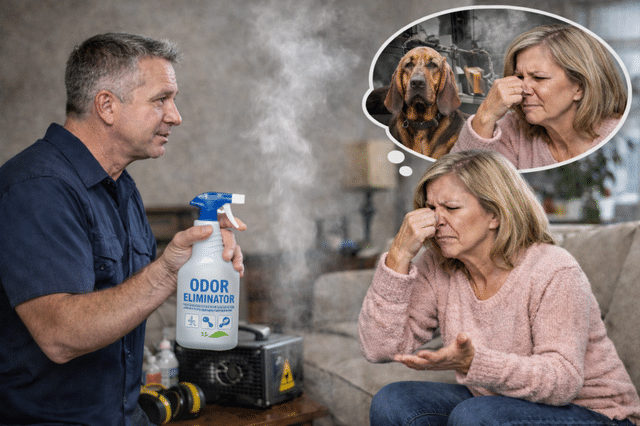
I have also had customers say, "I have the nose of a bloodhound." And I always have to take a step back and explain something important.
Everything we do in odor removal is based on human detection levels, not animal-level sensitivity. A bloodhound can detect scent at levels far beyond what any human can perceive. Our goal is to remove odor to the point where it is no longer detectable to people, because that is what actually impacts livability.
So even in cases where someone believes they can detect something at an extreme level, we still have to ground the conversation in what is realistically measurable and relevant to human environments.
Expectation plays a bigger role than most people realize. If someone is convinced the odor cannot be eliminated, or believes they have an unusually heightened sense of smell, their brain often reinforces that experience.
I have also seen cases where post-illness factors come into play. Especially in recent years, people recovering from viral infections report distorted or phantom smells. That adds another layer of complexity, because now you are dealing with something that has nothing to do with the environment at all.
This is where the real business challenge comes in.
You can do a perfect job and still end up with an unhappy customer.
From their perspective, the job is not done until they no longer smell anything. That makes sense. That is what they hired you for.
But from a technical standpoint, the job is complete when the odor source is eliminated and there are no odor molecules left to detect.
Those two realities do not always line up.
I have seen companies get stuck in what I call the re-service loop. They go back again and again, re-treating, rechecking, trying to fix something that is not there anymore. It costs time, money, and eventually wears down both the company and the customer.
There is also a real risk to your reputation. Even when you do everything correctly, these situations can lead to negative reviews or refund demands. And the hardest part is, you cannot physically prove to someone that what they are smelling does not exist.
That brings me to the hard truth, and it is one that is not always easy to say out loud.
You cannot remove an odor that is not physically there.
Our entire industry is based on removing odor-causing molecules. If those molecules are gone, there is nothing left to clean, neutralize, or treat. At that point, the issue is no longer environmental. It is perceptual.
No amount of ozone, hydroxyl treatment, fogging, or deep cleaning is going to solve a problem that exists in perception rather than in the space itself.
So what do you do?
First, you make absolutely sure the odor is truly gone. I never jump to the conclusion of perceived odor without verifying everything. I re-inspect, check hidden areas, look at the HVAC system, and rule out any possible secondary sources. You have to be certain.
Once you are confident in the work, the next step is communication.
And this is where a lot of companies struggle.
You cannot tell someone, "It is all in your head." Even if that is technically what is happening, it will destroy trust instantly.
Instead, I explain how the smell system works. I explain that what they are experiencing is real to them, but it may not be coming from a physical source anymore. That distinction matters more than most people realize.
Another thing I have learned is that this conversation should happen before the job is finished, not after. Setting expectations early makes a huge difference. When clients understand that odor removal deals with physical sources, but perception can sometimes linger, it prevents a lot of conflict later.
In some cases, I will suggest simple things to help them transition, like improving airflow, spending time in the space to allow their senses to normalize, or even just giving it time. And if it seems persistent or unusual, I will recommend they speak with a medical professional.
At the end of the day, this is one of those challenges that separates experienced companies from the rest.
Because the job does not always end when the odor is gone.
Sometimes, that is when the real work begins.
And understanding the difference between an actual odor problem and a perceived odor experience is what allows you to handle these situations professionally, without chasing a problem that no longer exists.
If you have been in this business and dealt with this before, you know exactly what I am talking about.
And if you are a customer going through this, just know this. What you are smelling feels completely real. But the solution may not be in more cleaning. It may be in understanding how the brain processes smell.