
Can You Inhale Fecal Particles From a Restroom Hand Dryer?
What the Research Really Says
Most of us do not think too deeply about the hand dryer in a public restroom. We wash our hands, place them under the machine, wait for the blast of air, and move on with our day.
But in recent years, restroom hand dryers have raised a bigger hygiene question: can these machines spread bacteria, microorganisms, or even microscopic fecal particles into the air?
The answer is not meant to scare people, but it is worth understanding. Some modern hand dryers, including many Dyson Airblade models, are designed with HEPA filters that clean the air before it reaches your hands. That is a useful feature. However, public restrooms are complicated environments. Toilets, sinks, wet hands, shared surfaces, and moving air can all play a role in how germs travel.
So while a hand dryer is not automatically dangerous, it may contribute to the movement of microorganisms already present in the restroom.
How Hand Dryers Actually Work
Most restroom hand dryers work by pulling in air from the room and pushing it back out toward your hands. Traditional warm-air dryers heat that air and blow it slowly. Newer high-speed dryers use a much stronger stream of air to push water off your skin.
Some high-speed dryers include HEPA filtration. A HEPA filter is designed to trap very small airborne particles before the air exits the machine. In theory, that means the air being blown onto your hands may be cleaner than the air the dryer pulled in.
That sounds reassuring, and it can be. But the filter is only one part of the story.
Why People Are Concerned About Hand Dryers
The main concern is not just what comes out of the machine. It is what happens when powerful air hits wet hands in a public restroom.
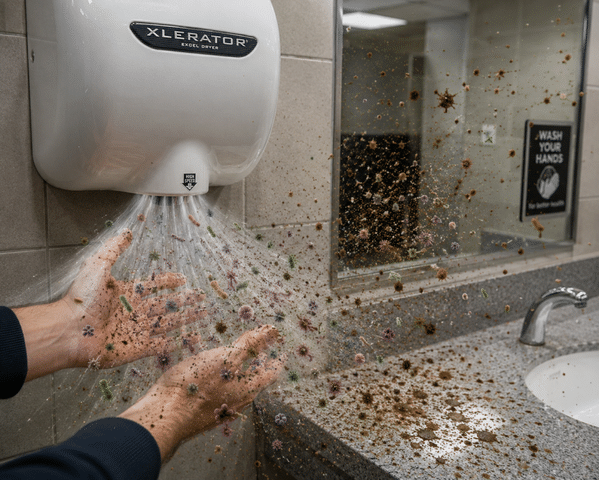
If someone has not washed their hands thoroughly, bacteria and other microorganisms may still be present on the skin. When a high-speed dryer blows air across those hands, tiny droplets can become airborne. Those droplets may then move through the restroom and settle on nearby surfaces.
Researchers have found that some hand dryers can increase the spread of airborne bacteria compared with paper towels. This does not necessarily mean every person who uses a hand dryer is at serious risk. It does mean that strong airflow can move particles around in ways paper towels do not.
Where Fecal Particles Come From
Public restrooms are unique because toilets can release microscopic droplets into the air when flushed. This is sometimes called a toilet plume.
A toilet plume may contain tiny particles from the toilet bowl, including bacteria, viruses, and microscopic fecal matter. These particles can float in the air for a period of time and eventually settle on surfaces like sinks, counters, door handles, floors, walls, and hand dryer exteriors.
This is one reason restroom hygiene is about more than just whether a hand dryer has a filter. The surrounding environment matters too.
Can You Inhale Fecal Particles From a Hand Dryer?
It is possible to inhale tiny airborne particles in a public restroom, including particles that may contain bacteria or traces of fecal matter. That sounds unpleasant, but it is important to keep the risk in perspective.
Exposure does not automatically mean infection.
For someone to actually become sick, several things usually need to happen. A harmful microorganism has to be present. It has to remain alive and infectious. There has to be enough of it to matter. It also has to enter the body in a way that can cause illness.
For most healthy adults, the risk from occasional use of a public restroom hand dryer appears to be relatively low. Still, the concern is more meaningful for people who may be more vulnerable, such as young children, older adults, people with weakened immune systems, hospital patients, or individuals with chronic respiratory conditions.
That is why many healthcare settings prefer paper towels. In places where infection control is especially important, reducing unnecessary airborne movement can be a smart precaution.
Do HEPA Filters Make Hand Dryers Safer?
HEPA filters can make a meaningful difference. A properly functioning HEPA filter can capture many microscopic particles from the air before that air is blown onto your hands. This is why many premium hand dryers promote HEPA filtration as a hygiene feature.
However, a HEPA filter does not solve every problem.
It cannot guarantee that someone washed their hands correctly. It cannot stop droplets from poorly washed hands from becoming airborne. It cannot remove germs from nearby surfaces. It also cannot eliminate every particle already floating in the restroom.
In other words, HEPA filtration helps, but it does not make a public restroom sterile.
HEPA Filters Must Be Maintained to Work Properly
One detail that often gets overlooked is maintenance.
A HEPA filter is not something that works forever without attention. Over time, it collects dust, debris, and particles from the surrounding air. If the filter becomes too dirty, damaged, incorrectly installed, or overdue for replacement, it may not perform the way the manufacturer intended.
That matters because restroom users usually have no way of knowing whether a hand dryer has been properly maintained. A machine may say it has HEPA filtration, but unless the filter is inspected and changed on schedule, its real-world effectiveness may be reduced.
A HEPA filter is only as good as the maintenance behind it.
For facility managers, this means filter replacement should not be treated as optional. For users, it means HEPA filtration is a positive feature, but not a guarantee.
Are Paper Towels More Hygienic?
In many situations, paper towels may be the more hygienic option.
Paper towels dry hands without blasting air across the skin or through the room. They also create friction, which may help remove some remaining microorganisms after washing. Because they do not create strong air currents, paper towels are less likely to spread droplets or particles around the restroom.
This is why paper towels are often preferred in hospitals, clinics, food-service areas, and other settings where hygiene standards are especially important.
That does not mean every hand dryer should be avoided at all costs. But if your goal is to reduce airborne dispersal as much as possible, paper towels are generally the safer choice.
The Biggest Hygiene Factor Is Still Handwashing
The most important point is simple: how well you wash your hands matters more than how you dry them.
Many people do not wash long enough. Some skip soap. Others miss fingertips, thumbs, the backs of the hands, or the areas between fingers. If germs are left behind after washing, any drying method becomes less effective.
For better hygiene, wash with soap and water for at least 20 seconds. Scrub all parts of your hands, rinse well, and dry completely. Wet hands can transfer germs more easily than dry hands, so drying is not just about comfort. It is part of the hygiene process.
How to Protect Yourself in Public Restrooms
You do not need to panic about using a public restroom, but a few small habits can reduce your exposure.
Wash your hands thoroughly every time. Use paper towels when they are available, especially in crowded or poorly ventilated restrooms. Try not to touch your face immediately after using shared facilities. If a paper towel is available, use it to open the restroom door. Avoid placing your phone, bag, or personal items on restroom counters. Hand sanitizer can also be useful after leaving the restroom, especially if the space looks poorly maintained.
These steps are simple, but they can make a real difference.
So, Should You Be Concerned About Hand Dryers?
The honest answer is somewhere in the middle.
Public restroom hand dryers are not inherently dangerous, and most healthy people are unlikely to become sick simply from using one. At the same time, research has shown that high-speed dryers can contribute to the movement of bacteria, microscopic fecal particles, and other microorganisms that may already be present in the restroom environment.
Modern hand dryers equipped with HEPA filters are certainly an improvement over older models. These filters can help clean the air before it is blown onto your hands, but they are not a perfect solution. Their effectiveness depends on regular maintenance and timely replacement, something restroom users have no way of verifying. A HEPA filter that has not been properly serviced may not provide the level of protection the manufacturer intended.
It is also important to remember that no hand dryer, regardless of how advanced it may be, can compensate for poor handwashing habits or an unsanitary restroom. Clean hands start with proper washing, not with the machine used to dry them.
If minimizing exposure to airborne germs is a priority for you, paper towels are generally considered the more hygienic option because they do not create powerful air currents that can move particles around the room. That is one reason they are still the preferred choice in many hospitals and healthcare settings.
Ultimately, there is no need to fear every public restroom hand dryer. The better approach is to focus on the factors you can control. Wash your hands thoroughly with soap and water, dry them completely, avoid touching unnecessary surfaces, and choose paper towels when they are available.
Good hygiene is not about relying on a single product or technology. It is about combining clean habits, well-maintained facilities, and a little common sense. When those elements work together, you are doing far more to protect your health than any hand dryer ever could.