
Why the Right Odor Removal Company Matters More Than Any Single Product
When you're dealing with a difficult odor problem, it's easy to focus on the product. Which enzyme cleaner should I use? Do I need ozone? Will a deodorizer work? Is there something I can spray that will finally make the smell go away?
At Stat Sanitizing, we look at odor removal differently.
There is no single product, chemical or technology that's right for every odor problem. Professional odor removal is about identifying the source, understanding what you're dealing with and choosing the most effective tools for that particular situation.
Enzymes are one of those tools. And when we determine that an enzymatic process is appropriate, we don't settle for an ordinary formulation.
Enzymes Are One Tool in the Toolbox
Enzymes can be extremely effective for odors associated with organic contamination, including urine, feces, vomit, food waste, proteins, fats and oils. They work by helping break down the organic material contributing to the odor rather than simply covering the smell with another fragrance.
But not every odor is caused by the same material, and not every odor should be treated with enzymes. That's an important distinction.
A professional odor-remediation company should have multiple treatment options available and understand the strengths and limitations of each one. The goal shouldn't be to make every odor problem fit the treatment you happen to have. The treatment should fit the odor problem.
That's why we think of odor remediation as a toolbox. Enzymatic treatment may be the right tool for one situation, while another odor source may require an entirely different process or a combination of processes.
When We Use Enzymes, We Use a 25-Enzyme System
Even within enzymatic odor remediation, formulations can vary significantly.
According to the manufacturer of the professional enzymatic formulation used by Stat Sanitizing, most enzymatic products contain approximately 3 to 6 enzyme types. The professional system we've chosen incorporates 25 different enzymes and coenzymes.
Why does that matter?
Different enzymes work on different types of organic material. Proteases break down proteins. Lipases target fats and oils. Amylases work on starches and sugars. Ureases and uricase target compounds associated with urine, including ammonia and uric acid. Other enzymes help address additional components of complex organic contamination.
A difficult odor source may contain several of these materials at the same time. Having a broader enzyme system gives us more enzymatic activity to work with when we're treating complex organic contamination.
But here's the important part: Twenty-five enzymes don't make the decision. An odor professional does.
The Best Enzyme Won't Work If It Doesn't Reach the Source
Pet urine is a perfect example. You may see a urine stain on the carpet, but the contamination may extend well beyond what is visible. Urine can travel through carpeting, into padding and eventually into wood, subflooring, concrete, grout and other porous materials.
You could have the most sophisticated enzyme formulation available, but if it's applied only to the surface while the contamination is underneath, the odor may return. That's not necessarily a failure of the enzyme. It's a failure to reach the source.
This is why professional odor remediation begins before any treatment is applied. We need to understand what caused the odor, where the contamination traveled, which materials have been affected and which treatment gives us the best opportunity to address it.
There Is No Universal Odor Treatment
One of the biggest differences between professional odor remediation and simply purchasing an odor-control product is having options.
Some odor problems involve organic contamination where enzymes can be extremely useful. Others may involve cigarette smoke, cannabis, cooking odors, chemical odors or contamination that has penetrated building materials. Certain situations may require cleaning and source removal before any deodorization process begins. Others may require multiple treatment methods.
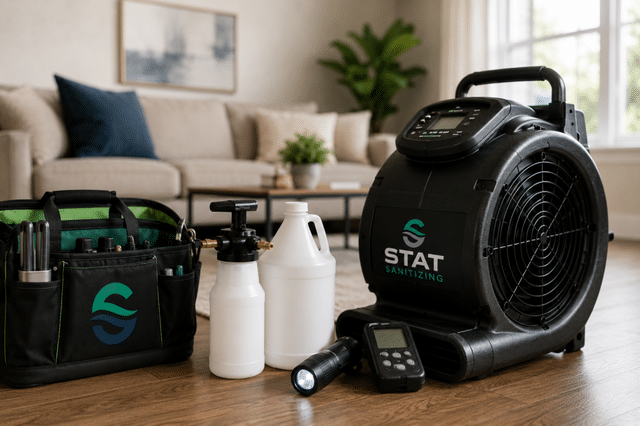
Trying to solve every odor problem with the same chemistry is like trying to repair everything in your house with one tool.
Sometimes you need a screwdriver. Sometimes you need a wrench. Sometimes you need an entirely different approach.
The value isn't simply having the tools. It's knowing which one to use.
Better Tools Still Matter
Saying that professional expertise matters most doesn't mean the quality of the tools is unimportant. Quite the opposite.
Once we've determined which process is appropriate, we want the most effective professional tools available to perform it.
That's exactly why we use a 25-enzyme system when enzymatic remediation is called for. We could use a simpler formulation containing only a handful of enzymes. We choose not to.
The same philosophy applies throughout our odor-remediation services. We don't select a treatment because it's convenient or because it's the one process we happen to offer. We evaluate the odor problem first and then determine which professional tools are appropriate for the job.
The right tool matters. Knowing when and how to use it matters even more.
Choosing the Right Odor Removal Company Is the Most Important Step
When an odor keeps returning, choosing another product off the shelf may not be the answer. The more important decision may be choosing the right company to determine why the odor is there in the first place.
A professional odor-remediation company should be able to look beyond the smell itself. Where is it coming from? What is producing it? Has it penetrated porous materials? Can those materials be treated effectively? Does the source need to be physically removed? Which treatment method is appropriate? Would combining methods produce a better result?
Those decisions can have a greater impact on the outcome than the name on any bottle.
At Stat Sanitizing, we don't believe in a one-size-fits-all odor treatment. We believe in having an extensive professional toolbox and selecting the most effective tools based on the odor problem in front of us.
Our 25-enzyme system is a good example. It's a sophisticated professional tool that gives us considerably more enzymatic capability than a basic 3-to-6-enzyme formulation. But it's still just one tool.
The real advantage is the professional process behind it.
Don't Just Treat the Odor. Choose the Right Process.
If you've repeatedly cleaned, sprayed, deodorized or treated an area and the odor keeps returning, continuing to try different products can become an expensive cycle. Meanwhile, the actual source may still be sitting beneath the carpet, inside a porous material or somewhere you haven't been able to identify.
Addressing the problem sooner can also matter. When contamination continues to affect porous materials, remediation can become more involved and potentially more expensive.
That's why the first question shouldn't always be, "What product should I use?"
A better question may be, "Who has the experience and the tools to figure out what's causing this?"
At Stat Sanitizing, enzymes are one tool in our toolbox. When enzymes are appropriate, we've chosen a professional 25-enzyme system because we want an effective tool for the job. When enzymes aren't appropriate, we have other treatment options.
Because professional odor removal isn't about having one miracle product. It's about having the right tools, the experience to choose between them and knowing how to use them effectively.
Choose the process before the product. Call Stat Sanitizing and let us determine the right approach for your odor problem.